SacroIliac (SI) Joint Pain Treatment
Innovative treatments for 3D patching & biologic repair of SI Joint Instability & Arthritis

The sacro-iliac joint (SI Joint) is a weight-bearing cartilage joint like many other joints in the body, but unlike other joints, it is not intended to move. It is actually built to be stable, but when injured, it can become unstable and loose. The capsular ligament wraps around the joint to hold it in place, but many things can loosen and destabilize the joint, including trauma like falls, motor vehicle accidents, giving birth, connective tissue disorders, excessive wear and tear, and many other mechanisms. When the joint is unstable, it shifts around more under load, further stretching and straining the ligaments and wearing down the cartilage more quickly. Eventually the joint can erode cartilage down to the bone and form bone spurs and subchondral cysts. SI joint issues are often missed and can cause significant pain even in phases where they become obvious on imaging. Many people push through the pain thinking it is just a minor issue at first, but it tends to get worse and more problematic over time. SI joint problems can occur at any age, from young athletes to elderly patients. Sometimes these problems imitate other conditions or are associated with adjacent pathologies, like Bertolotti's syndrome, pars fractures, degenerative disc collapse, facet arthritis, lumbarization or sacralization of vertebrae, spine fractures, sacral fractures, prior spine fusions, and many others.
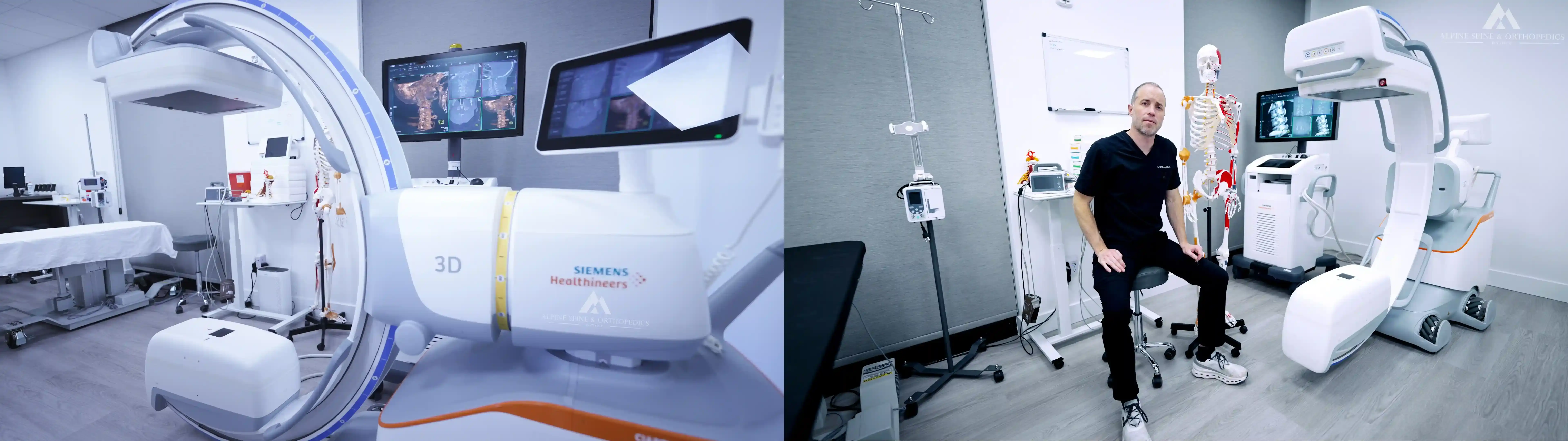
We utilize cutting-edge tissue-engineering approaches to treating SI joints with “stem cell patching” and "bone marrow grafting" procedures that involve grafting of bone marrow and concentrated stem cell patching with a sticky protein scaffolding matrix precisely placed directly into the joint and around the supporting ligaments under high-resolution 3D image-guidance. This form of biological fixation recapitulates the natural way of achieving stabilizationa nd repair without all the irreversible consequences of hardware implantation. The stem cells used are mesenchymal stem cells (MSCs) and MUSE cells concentrated and grafted from the patient’s own bone marrow, which are already primed for orthopedic tissue repair and which avoid any immunologic rejection response for optimal integration and remodeling (as opposed to foreign cells which express immunologic recognition markers as they integrate and differentiate causing rejection). The stem cells are in concentrated form with a scaffolding matrix that helps them integrate and remodel injuries over time. These stem cell patches help re-pave the cartilage similar to how a pothole in the road is patched. The stem cell patches also coat the internal capsular ligament around the joint, then the needle is redirected to patch around the outer ligaments of the joint. This helps stabilize and preserve the natural biomechanics of the joint without hardware fixation or fusion (but in more severe cases hardware fixation may be necessary). This procedure is done under IV sedation using minimally-invasive tools like needles, trocars, cannulas, and/or endoscopes with the most advanced high-resolution 3D robotic image-guidance, so there are no incisions nor sutures and patients can walk out afterwards.
STEM CELL PATCHES:
Bone Marrow Grafting + Concentrated Stem Cells + Scaffolding Matrix + Peptide Signaling Factors
The benefits of our 3D-guided stem cell patching procedure include:
1) It is minimally-invasive and far less painful than other surgical options (you can go home the same day and generally feels sore for only a short time after the procedure).
2) It does not implant any hardware and does not disrupt the underlying mechanics of the spine and hip, but instead uses a more natural approach (grafting and patching for biological fixation).
3) Multiple issues can be targeted and treated in the same visit, including spine fractures, disc bulges, nerve impingement, facet arthritis, SI joint dysfunction, ligament instability, and so on.
4) In cases of success, it saves patients from the consequences of much bigger surgeries and from a lifetime of painful surgical revisions.
5) In case of failure to fully repair, it can be repeated and it does not alter any future plans for spine surgery (and in fact, it can still help repair and reinforce surrounding tissues like ligament injuries, disc bulges, facet joint cartilage damage, nerve injuries, and so on, which all still help improve function and avoid surgery, as well as reinforce surrounding tissues to help improve outcomes if surgery ever becomes necessary).
Dr. McMurtrey often operated on some of the most complex spine cases including massive cranium-to-sacrum fusions in patients who had often started down the spine surgery path many years prior and who had been through numerous revisions surgeries through life, eventually extending the fusion construct all the way up the spine and down into the SI joints. Dr. McMurtrey often thought that if we could go back in time before the first fusion and save even a few of these patients from having to go down this road, then it would be completely life changing for them. He studied biomedical engineering and tissue engineering at the University of Oxford, earning honorary distinction for his work creating 3D tissue structures from patients' own stem cells using guided signaling factors and scaffolding matrix architecture. He is the only doctor who has both surgical training and stem cell research background at top research institutions, and he is currently the only doctor in the world who is using bone marrow grafting, concentrated stem cells, scaffolding matrix, and peptide signaling factors to achieve tissue repair under 3D image-guided techniques. More information on scaffolding matrix, stem cells, and peptides can be found at the links, and each patch composition is customized for each particular tissue and injury.
The following video shows a brief overview of this type of procedure, and several case examples are shown on our Instagram & Facebook pages, and many of our patients have also kindly described their experiences and outcomes as found in our reviews.
-----
ASOI © 2024 All Rights Reserved*Disclaimer: The information presented here is for informational use and cites the ongoing cutting-edge research and medical advancements on these relevant topics and advancements. We seek to always provide the highest-quality evidence-based care to our patients customized for their specific conditions, injuries, and diagnoses. The FDA does not regulate the practice of surgery or medicine, but rather regulates medical marketing of devices and drugs. The FDA also does not conduct clinical trials nor do they attempt to discover new treatments. Breakthrough technologies typically require years to decades of research work, which in some cases can optionally be submitted to the FDA if there is sufficient financial backing. Thus the FDA has not yet studied, evaluated, or formally approved many regenerative therapies (nor many other surgical procedures) currently practiced by many of the top physicians and surgeons in the United States and around the world. Some therapies, products, or interventions may still be considered standard practice despite still being "investigational" or "off-label" even with substantial evidence of efficacy, and strangely, many practitioners continue to do some types of procedures even when evidence exists to the contrary (e.g., epidural steroid injections are not FDA-approved and data suggest little benefit but many potential risks of harm, yet approximately 10 million are performed each year in the USA). Common spine surgery techniques also have no specific FDA-approval because the FDA does not regulate surgery nor conduct studies on surgical outcomes. Thus there are many treatments, interventions, and protocols routinely practiced in medicine and surgery which the FDA has not studied nor formally approved yet which have demonstrated overwhelming evidence of efficacy and clinical benefit, while many FDA-approved therapies, standard insurance-covered treatments, and common surgeries can actually have high rates of failure and complication, so patients must always weigh benefits versus risks. Many different applications of regenerative therapies take a newer and more advanced approach to tissue repair and continue to be researched and optimized by our institute and in collaboration with other institutions around the world. In general, treatments may include FDA-approved therapies as well as additional investigational, alternative, or regenerative therapies and interventions, and we always cover potential risks and benefits of these options. The rapid evolution and advancement of surgical and medical interventions demand that physicians continually update their knowledge and practice techniques to adapt to future improvements and advancing technologies for the ultimate benefit of their patients. These statements have not been evaluated by the FDA, and the treatments and products presented here are for educational purposes and are not guaranteed to diagnose, treat, cure, or prevent any specific disease or condition. The information here does not form a doctor-patient relationship nor does it constitute medical advice. All injuries and conditions should be formally evaluated by a knowledgeable medical professional whereby standard treatments and additional therapeutic interventions may be considered with the diagnosis and treatment plan.